
Automation in High‑content Screening for GPCR Drug Discovery: Boosting Reproducibility and Throughput

G Protein-Coupled Receptors (GPCRs) remain the most significant class of therapeutic targets, accounting for approximately 35 % of all FDA-approved drugs. However, the complexity of their signaling pathways, characterized by biased agonism, allosteric modulation, and spatial compartmentalization, presents a formidable challenge for traditional screening methodologies. As the pharmaceutical industry shifts from simple “on/off” biochemical assays toward more physiologically relevant phenotypic models, the integration of high-content screening (HCS) has become a critical tool for interrogating GPCR biology at scale.
The true impact of HCS in GPCR drug discovery is even more impactful when automation is embedded across the entire workflow, from assay execution to image analysis and data interpretation. By combining multi-parametric imaging with sophisticated robotics, researchers can now capture the spatiotemporal dynamics of GPCR behavior at scale, ensuring that the wealth of data generated is both reproducible and statistically robust.
Variability and Bottlenecks in Early-Stage GPCR Drug Discovery
Early-stage GPCR drug discovery is hindered by significant technical hurdles that contribute to high attrition rates. A primary challenge is the inherent instability and conformational flexibility of GPCRs when removed from their native lipid environment. This instability complicates receptor purification and structural determination, making it difficult to capture the specific active or inactive states required for accurate pharmacological profiling. Furthermore, the lack of high-resolution structures, particularly for orphan receptors, limits the screening methods, making it difficult to predict ligand binding and activity.
Beyond structural constraints, the complex signaling nature of these targets adds layers of difficulty:
- Dynamic signaling like biased agonism, receptor internalization, and tachyphylaxis.
- Low expression and stability often hinder biophysical studies and lead to optimization challenges.
- The need for specific fluorescent tracers creates a significant bottleneck, as these tools often require time-consuming, bespoke optimization for each receptor, limiting overall throughput.
To navigate these complexities, standardizing the HCS workflow has become essential to maintain the integrity of delicate cell-based models and ensure reproducible results despite receptor instability. Ultimately, the integration of automation in drug discovery allows labs to move past these traditional bottlenecks, transforming high-resolution phenotypic data into actionable therapeutic leads.
How Automated High-Content Screening Enables Reproducible GPCR Assay Workflows
At its core, high-content screening automation aims to standardize every step of the experimental pipeline. Automated liquid handling, environmental control, and image acquisition reduce operator-dependent variation, while predefined protocols ensure consistency across plates, days, and laboratories. For GPCR assays, this level of control is essential to distinguish true pharmacological effects from experimental artifacts.
A well-designed automated HCS workflow typically integrates:
- Assay automation for cell seeding, compound addition, or labeling.
- Automated microscopy HCS platforms for consistent image acquisition
- Centralized high-content screening software for image processing and feature extraction.
By minimizing manual intervention, automated HCS improves reproducibility while enabling higher experimental density. This is particularly valuable for GPCR assays that rely on subtle phenotypic changes, such as receptor internalization or signaling compartmentalization, where consistency in timing and imaging parameters is critical. The use of lab automation for high-content screening facilitates the transition from endpoint assays to kinetic measurements in GPCR.

Key Technologies and Software Driving Automation in HCS Platforms
Automation in GPCR-focused HCS relies on the tight integration of experimental robotics, advanced imaging, and data-driven analysis to manage biological complexity at scale. Modern tools combine assay automation, live-cell imaging, and computational triaging to enable reproducible workflows in GPCR drug discovery.
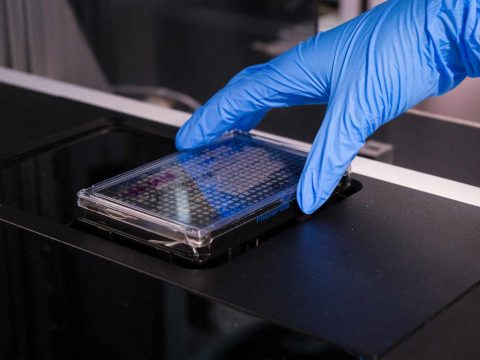
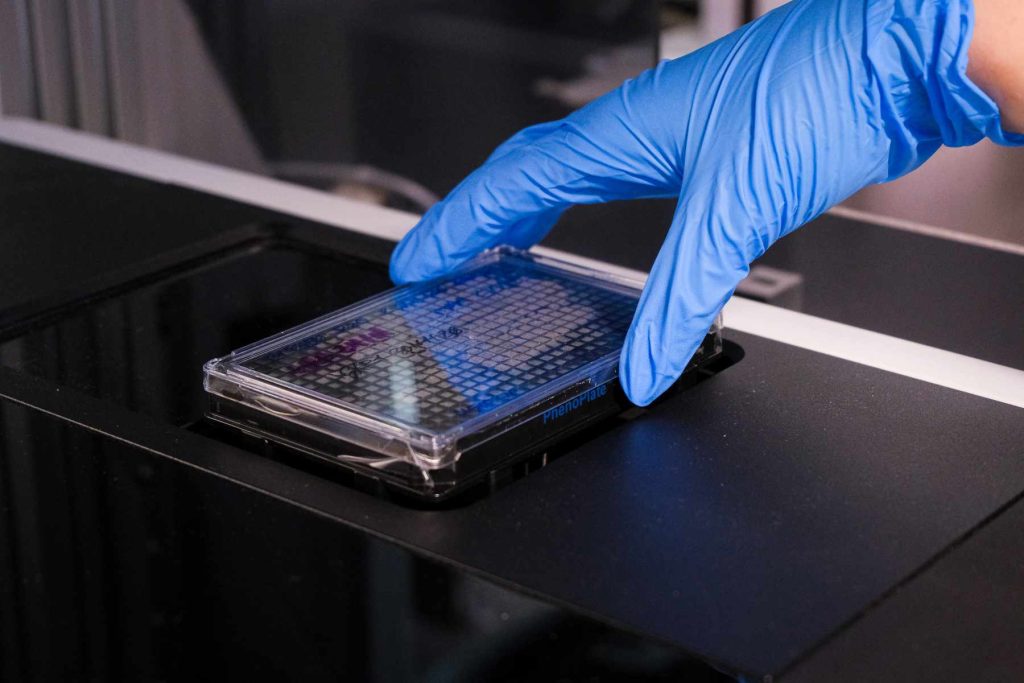
At the experimental level, lab automation for high-content screening is driven by robotic liquid-handling systems that standardize assay setup across 96–384-well formats. These platforms automate cell seeding, transfection, compound dosing, and staining, reducing variability and increasing throughput in complex GPCR assays. Open and programmable systems can be directly coupled to automated microscopy, enabling kinetic profiling of GPCR signaling events during live-cell imaging.
Imaging hardware plays a central role in these workflows. Automated high-content imaging systems, including platforms supporting confocal imaging, enable multiparametric analysis of GPCR signaling, trafficking, and pathway-specific responses. Commercial solutions integrate acquisition and analysis within a unified environment, streamlining the end-to-end HCS workflow.
Regarding the software, HCS equipment increasingly incorporates AI-powered data analysis to manage the volume and complexity of image-based datasets. In parallel, virtual and AI-driven screening methods are used upstream to prioritize GPCR-focused libraries, reducing the number of compounds entering resource-intensive imaging campaigns.
Together, these technologies form a cohesive automation ecosystem that enhances reproducibility, scalability, and decision-making in high-content GPCR screening.

Figure 1. Conceptual overview of ligand-based and structure-based virtual screening depicting 3kPZS (a known agonist), which is a pheromone compound involved GPCR signaling, and a homology structure of its receptor, the SLOR1 (sea lamprey receptor 1) GPCR. Source: Raschka S, Kaufman B. Machine learning and AI-based approaches for bioactive ligand discovery and GPCR-ligand recognition. Methods. 2020 Aug 1;180:89-110.
Scaling Throughput and Reliability With AI-enhanced HCS for GPCR Targeting
AI has become a central enabler of scalability in modern GPCR drug discovery, extending the impact of the automation of high-content screening well beyond experimental execution. In AI-enhanced HCS workflows, machine learning operates at two complementary levels: virtual triage and automated analysis of image-based phenotypes at scale.
- Upstream: virtual triage
GPCR-focused AI models are used to narrow down large compound libraries before any lab experiments begin. These models can predict whether compounds act as agonists or antagonists, how strongly they bind, and whether they show signaling bias. By reducing tens of millions of molecules to a smaller, GPCR-relevant set, virtual triage increases effective throughput and lowers the experimental workload in the HCS workflow.
- Downstream: scaling phenotypic readouts and robustness
AI-powered HCS data analysis helps extract and compare complex cellular responses across large screening campaigns. Deep learning improves image segmentation and feature extraction, making phenotypic profiles more consistent and reliable. Feature-based and representation-learning approaches support scalable hit ranking and quality control. When combined with automated microscopy and modern high-content screening software, these methods enable reliable analysis of large screens without losing biological detail.
Automation and AI has become a strategic requirement for high-content GPCR screening, enabling discovery teams to reduce variability, scale throughput, and extract reliable insights from complex GPCR biology through integrated assay execution, imaging, and AI-driven analysis.
At Celtarys, we apply high-content screening strategies that combine assay design expertise, HCS imaging, and advanced data analysis to generate reproducible, decision-ready datasets tailored to GPCR targets, specifically to CB2.
Learn how our screening services can accelerate and de-risk your GPCR drug discovery programs!
References
Greenwald E, Posner C, Bharath A, Lyons A, Salmerón C, Sriram K, Wiley SZ, Insel PA, Zhang J. GPCR Signaling Measurement and Drug Profiling with an Automated Live-Cell Microscopy System. ACS Sens. 2023 Jan 27;8(1):19-27. doi: 10.1021/acssensors.2c01341
Haasen D, Schnapp A, Valler MJ, Heilker R. G protein-coupled receptor internalization assays in the high-content screening format. Methods Enzymol. 2006;414:121-39. doi: 10.1016/S0076-6879(06)14008-2
Laeremans T, Sands ZA, Claes P, De Blieck A, De Cesco S, Triest S, Busch A, Felix D, Kumar A, Jaakola VP, Menet C. Accelerating GPCR Drug Discovery With Conformation-Stabilizing VHHs. Front Mol Biosci. 2022 May 23;9:863099. doi: 10.3389/fmolb.2022.863099
Lo CSY, Taneja N, Ray Chaudhuri A. Enhancing quantitative imaging to study DNA damage response: A guide to automated liquid handling and imaging. DNA Repair (Amst). 2024 Dec;144:103769. doi: 10.1016/j.dnarep.2024.103769
Raschka S, Kaufman B. Machine learning and AI-based approaches for bioactive ligand discovery and GPCR-ligand recognition. Methods. 2020 Aug 1;180:89-110. doi: 10.1016/j.ymeth.2020.06.016
Zhang H, Fan H, Wang J, Hou T, Saravanan KM, Xia W, Kan HW, Li J, Zhang JZH, Liang X, Chen Y. Revolutionizing GPCR-ligand predictions: DeepGPCR with experimental validation for high-precision drug discovery. Brief Bioinform. 2024 May 23;25(4):bbae281. doi: 10.1093/bib/bbae281
Related posts
Picking an E3 Ligase Assay: FP, TR-FRET, ELISA, NanoBRET and More

PROTAC Hook Effect: How E3 Ligase and Target Protein Binding Affinity Shapes Degradation Efficiency



VHL, CRBN, and Emerging Ligases like DCAF: Selecting E3 Ligase Handles for PROTAC Drug Discovery



PERTE SALUD Proyecto Nº: IDI-2025-0751
Título: TERAPIAS AVANZADAS EN INMUNOONCOLOGÍA: UNA ESTRATEGIA INNOVADORA
BASADA EN LA DEGRADACIÓN DIRIGIDA DE GPCR EN EL EJE ADENOSINÉRGICOS

EIC Pathfinder; Project name: Unisens; Universal GPCR Activity Sensor for Next Generation Drug Discovery


Esta entidad fue beneficiaria de las ayudas para la ejecución de acciones de promoción exterior de las empresas gallegas. El objetivo principal de estas ayudas es incentivar la realización de acciones de promoción exterior generadoras de ventajas competitivas. El resultado que se pretende conseguir es el impulso de las pymes y sus productos y servicios, aumentando el número de empresas de base exportadora.
Celtarys Research is beneficiary of a WomenTechEU grant supporting deep-tech start-ups led by women


Principia 2021 Program
Celtarys staff has been funded by the Xunta de Galicia within the framework of the PRINCIPIA 2021 Program of the Galician Innovation Agency (GAIN)
InnovaPEME Program
Celtarys Innovation Plan has been funded by the InnovaPEME 2022 program of the Galician Innovation Agency (GAIN)

Bonos de Innovación de Celtarys Research (026)
Para promover o desenvolvemento tecnolóxico, a innovación e unha investigación de calidade. Esta operación está financiada pola Xunta de Galicia, a través de axudas concedidas pola Axencia Galega de Innovación, dentro do programa de axudas a empresa Bonos de innovación 2022.


Celtarys Research is part of the public-private consortium developing the project PREDICTEAM
New prognostic quantitative biomarker assays for predicting patient response to immune checkpoint inhibitor (ICI) treatment


NEOTEC · CDTI — Ministerio de Ciencia e Innovación
The Project ‘New chemical conjugation technology for therapeutic targets’ has been founded by CDTI under its program NEOTEC. The NEOTEC program objective is supporting the establishment and consolidation of technology-based enterprises. A technology-based company (EBT) is a company whose activity focuses on the exploitation of products or services that require the use of technologies and knowledge developed since the research activity. The EBT base their business strategy or activity in the intensive domain of scientific and technical knowledge. Budget awarded: 416.177€ | Execution dates: 1/1/2023 – 31/03/2024