
CB2 Receptor: Therapeutic Target for Inflammation, Pain, and Oncology Drug Discovery
The CB2 receptor occupies an unusual position in endocannabinoid system drug discovery: a target with a clear therapeutic rationale and a long record of preclinical success that has not yet translated into the clinic. Its appeal is easy to state. CB2 sits on immune cells rather than neurons, so engaging it modulates inflammation without the psychoactivity that derailed CB1-directed programs. Yet the relatively few CB2-selective agonists tested in clinical trials have shown limited efficacy. Understanding why requires looking closely at receptor biology, signaling bias, and the assay strategies that separate a promising ligand from a reproducible one.
CB2 Receptor Biology: Tissue Distribution, Signaling, and Differences from CB1
Cloned from the HL-60 promyeloid line in 1993, cannabinoid receptor 2 is a 360-amino-acid class A GPCR sharing 44% homology with CB1. That modest sequence identity rises to roughly 68% across the transmembrane domains, which is precisely why subtype selectivity remains a medicinal chemistry challenge.
The practical distinctions that shape target selection:
- CB2 receptor location: predominantly peripheral and immune. Expression is highest in B cells, followed by NK cells, monocytes, and T cells, with the functional receptor also detected in perivascular microglia.
- CB1 vs CB2 receptors: CB1 dominates the CNS and mediates the psychoactive effects of THC, while CB2 governs immune responses. CB2 is not psychoactive; the intoxicating effects of cannabinoids are mediated by CB1.
- Inducibility: CB2 expression is not static. It rises in colonic epithelium, hepatic myofibroblasts, chondrocytes, and microglia under inflammatory conditions, making it a disease-responsive target rather than a constitutive one.
CB2 Receptor Activation: Gi/o Pathways, cAMP Modulation, and Immunomodulatory Mechanisms
What happens when CB2 receptors are activated depends on which branch of the cascade a given ligand favors, because the branches pull in opposite directions. Gi/o signaling cannabinoid coupling dominates and is the anti-inflammatory one: CB2 recruits Gαi/o almost exclusively, inhibiting adenylyl cyclase, lowering cAMP and preventing PKA activation, which is believed to block the NF-κB and CREB transactivation of inflammatory genes. The same receptor also drives p38 and ERK1/2 phosphorylation through Gβ and Gγ subunits, and this MAPK arm activates pro-inflammatory genes through those very same transcription factors.
Two further routes complete the picture. Gαs coupling has been reported only in rare instances, where it appears to support a PKA-dependent pro-inflammatory response, while Ca²⁺ signaling proceeds through phospholipase C downstream of Gαi/o. GRK phosphorylation of the C-terminal tail recruits β-arrestin1 and β-arrestin2, internalizing the receptor and phosphorylating ERK1/2 in turn. Ligands engage these arms unevenly: JWH-133 induces β-arrestin and cAMP signaling more potently than GIRK and ERK activation, whereas HU308 and HU910 show no strong bias.
CB2 as a Therapeutic Target in Inflammation and Immune-Mediated Diseases
The case for targeting CB2 receptor inflammation biology comes from genetics first. Cnr2-deficient mice generally show a pro-inflammatory phenotype, with elevated pro-inflammatory cytokines and increased neutrophil recruitment across models of liver injury, colitis, and endotoxemia; in alcoholic liver disease, TNF-α, IL-6, IL-1β, and IL-1α are all raised. Selective agonists, for their part, reduce cytokine release and shift macrophages toward an M2 phenotype.
What CB2 helps with, based on current evidence:
- Autoimmune and chronic inflammation: in rheumatic disease models, CB2 agonists improve inflammation and reduce pain concomitantly. In macrophages from celiac and pediatric IBD patients, which express less CB2 and skew toward M1, JWH-133 at 100 nM restores M2 polarization and improves intestinal barrier function.
- Tissue injury: HU308 and HU910 limit damage in sepsis, hepatic ischemia-reperfusion, and hepatorenal injury, partly by suppressing NLRP3 inflammasome activation through autophagy.
- Context dependence: in Th2-driven allergic airway inflammation, a CB2 receptor antagonist is the beneficial intervention, not an agonist.
CB2 Receptor in Pain Management and Neuroinflammation: A Non-Psychoactive Approach
CB2 receptor pain modulation is mediated by immune cells rather than neurons. Mice with myeloid-specific CB2 deletion develop mirror-image allodynia, while mice lacking only neuronal CB2 do not: strong genetic evidence that microglia and macrophages carry the analgesic signal.
CB2 receptor neuroinflammation data follow the same logic. Agonists reduce microglial activation and cytokine release after traumatic brain injury, stroke, and chemotherapy-induced neuropathy. Conformationally restricted analogs of synthetic cannabinoid designer drugs, developed at the University of Santiago de Compostela, restored viability from roughly 50% to 77-93% in LPS/IFN-γ-stimulated primary neurons while lowering ROS and caspase activity, an effect abolished by the CB2 antagonist SR144528. Crucially, the lead compound combines high in vitro BBB permeability with a functional selectivity ratio above 1780 over CB1, the margin that keeps psychoactivity off the table (Gioé-Gallo et al., 2025).
CB2 Receptor in Oncology: Tumor Microenvironment, Immune Modulation, and Emerging Targets
The role of the CB2 receptor in cancer runs in the opposite direction. Within the tumor microenvironment, the anti-inflammatory, pro-resolving phenotype that benefits autoimmune disease becomes a liability: RNAi screening identified CB2 as a key regulator of tumor-associated macrophage differentiation, and CB2 engagement drives the IL-10 and IL-6 secretion that sustains immunosuppressive niches.
Consequently, oncology programs are exploring inverse agonism. The CB2 inverse agonist AM630 delayed tumor growth in transplanted and genetic models and reduced TAM infiltration in GL261 glioblastoma, improving survival (Yoon and Grimsey, 2025). In the same model, the agonist GW405833 left the TAM population untouched, so the two directions are not symmetric. The direction of modulation, not merely the target, must be matched to the indication.
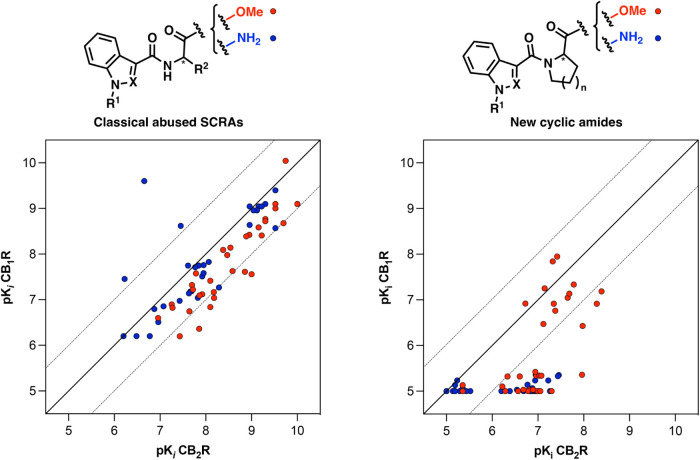
Figure 1. Affinity-selectivity plot for 64 classical abused SCRAs (left) and the 64 new derivatives (right) herein documented. Source: Gioé-Gallo C et al. Conformational Restriction of Designer Drugs Reveals Subtype-Selective and Biased CB2 Agonists with Neuroprotective Effects. J Med Chem. 2025;68(16):17103–17129
CB2 Receptor Agonists in Drug Discovery: Ligand Design, Selectivity, and Preclinical Strategies
The gap between preclinical promise and clinical outcome in cannabinoid drug discovery traces back to three recurring design problems:
- Insufficient selectivity: many tool compounds are only modestly CB2-preferring. JWH-015 shows roughly 28-fold selectivity, so micromolar concentrations routinely used in cell assays engage CB1 as well.
- Physicochemical liabilities: HU308 has a cLogP near 8.0, versus −0.4 for olorinab. Cryo-EM work shows that highly lipophilic ligands reach the orthosteric pocket through a TM1–TM7 membrane channel, while polar ligands enter via the extracellular route.
- Unmanaged signaling bias: agonists biased toward β-arrestin produce a markedly weaker anti-inflammatory cytokine profile than cAMP-biased ligands at the same receptor.
A productive CB2-selective agonist campaign therefore measures affinity and selectivity on every analog, early. The affinity data behind the series above, like most CB2 binding data, come from membrane preparations displacing [³H]CP55,940. Live-cell fluorescent readouts measure the same interaction with the receptor in its native cellular context.
Robust endocannabinoid system drug discovery depends on binding data you can trust from the first analog onward. At Celtarys, we run a CB2 binding screen that profiles your compounds in living cells, using our fluorescent probes in place of a radioligand. You get IC50 and Ki by Cheng-Prusoff, plus subcellular localization, toxicity, and morphological effects read from the same images.
Curious how your CB2 series behaves in living cells? Tell us where your program stands, and we’ll help you find the right place to start. Get in touch!
References
Gioé-Gallo C, Ortigueira S, Prieto-Díaz R, et al. Conformational Restriction of Designer Drugs Reveals Subtype-Selective and Biased CB2 Agonists with Neuroprotective Effects. J Med Chem. 2025;68(16):17103–17129. doi: 10.1021/acs.jmedchem.5c00604
Li X, Chang H, Bouma J, et al. Structural basis of selective cannabinoid CB2 receptor activation. Nat Commun. 2023;14:1447. doi: 10.1038/s41467-023-37112-9
Navarro G, Sotelo E, Raïch I, Loza MI, Brea J, Majellaro M. A Robust and Efficient FRET-Based Assay for Cannabinoid Receptor Ligands Discovery. Molecules. 2023;28(24):8107. doi: 10.3390/molecules28248107
Rakotoarivelo V, Mayer TZ, Simard M, Flamand N, Di Marzo V. The Impact of the CB2 Cannabinoid Receptor in Inflammatory Diseases: An Update. Molecules. 2024;29(14):3381. doi: 10.3390/molecules29143381
Yoon HH, Grimsey NL. Cannabinoid Receptor 2 (CB2) in Macrophages: A Promising Clinical Target for Immune Disorders. Int J Mol Sci. 2025;26(17):8657. doi: 10.3390/ijms26178657
Related posts
Molecular Glue Degraders: Mechanisms, E3 Ligase Biology, and Drug Discovery Strategies
Picking an E3 Ligase Assay: FP, TR-FRET, ELISA, NanoBRET and More


PROTAC Hook Effect: How E3 Ligase and Target Protein Binding Affinity Shapes Degradation Efficiency



Esta entidad fue beneficiaria de las ayudas para la ejecución de acciones de promoción exterior de las empresas gallegas. El objetivo principal de estas ayudas es incentivar la realización de acciones de promoción exterior generadoras de ventajas competitivas. El resultado que se pretende alcanzar es el impulso de las pymes y sus productos y servicios, aumentando el número de empresas de base exportadora.




PERTE SALUD Proyecto Nº: IDI-2025-0751
Título: TERAPIAS AVANZADAS EN INMUNOONCOLOGÍA: UNA ESTRATEGIA INNOVADORA
BASADA EN LA DEGRADACIÓN DIRIGIDA DE GPCR EN EL EJE ADENOSINÉRGICOS

EIC Pathfinder; Project name: Unisens; Universal GPCR Activity Sensor for Next Generation Drug Discovery

Esta entidad fue beneficiaria de las ayudas para la ejecución de acciones de promoción exterior de las empresas gallegas. El objetivo principal de estas ayudas es incentivar la realización de acciones de promoción exterior generadoras de ventajas competitivas. El resultado que se pretende conseguir es el impulso de las pymes y sus productos y servicios, aumentando el número de empresas de base exportadora.
Celtarys Research is beneficiary of a WomenTechEU grant supporting deep-tech start-ups led by women


Principia 2021 Program
Celtarys staff has been funded by the Xunta de Galicia within the framework of the PRINCIPIA 2021 Program of the Galician Innovation Agency (GAIN)
InnovaPEME Program
Celtarys Innovation Plan has been funded by the InnovaPEME 2022 program of the Galician Innovation Agency (GAIN)

Bonos de Innovación de Celtarys Research (026)
Para promover o desenvolvemento tecnolóxico, a innovación e unha investigación de calidade. Esta operación está financiada pola Xunta de Galicia, a través de axudas concedidas pola Axencia Galega de Innovación, dentro do programa de axudas a empresa Bonos de innovación 2022.


Celtarys Research is part of the public-private consortium developing the project PREDICTEAM
New prognostic quantitative biomarker assays for predicting patient response to immune checkpoint inhibitor (ICI) treatment


NEOTEC · CDTI — Ministerio de Ciencia e Innovación
The Project ‘New chemical conjugation technology for therapeutic targets’ has been founded by CDTI under its program NEOTEC. The NEOTEC program objective is supporting the establishment and consolidation of technology-based enterprises. A technology-based company (EBT) is a company whose activity focuses on the exploitation of products or services that require the use of technologies and knowledge developed since the research activity. The EBT base their business strategy or activity in the intensive domain of scientific and technical knowledge. Budget awarded: 416.177€ | Execution dates: 1/1/2023 – 31/03/2024