
Molecular Glue Degraders: Mechanisms, E3 Ligase Biology, and Drug Discovery Strategies
NanoBRET, KINOMEscan, ELISA, or fluorescence polarization: compare E3 ligase binding assay formats for PROTAC and molecular glue screening programs.
Targeted protein degradation has moved from preclinical proof of concept to a validated therapeutic modality in a little over two decades. Within it, molecular glue degraders occupy a peculiar position: chemically the simplest degraders, yet the hardest to design rationally. A molecular glue is a small monovalent compound that reshapes the surface of an E3 ubiquitin ligase so that it recognizes a protein it would otherwise ignore. Because it needs no linker and no second binding moiety, it stays within the molecular weight range of a conventional drug and avoids the permeability problems that come with bifunctional degraders. The result is a drug-like molecule that can eliminate transcription factors, scaffolding proteins, and other targets with no ligandable pocket of their own. Understanding how these compounds engage cereblon and related ligases, and how to detect that engagement biochemically, is now central to degrader programs across oncology, immunology, and beyond.
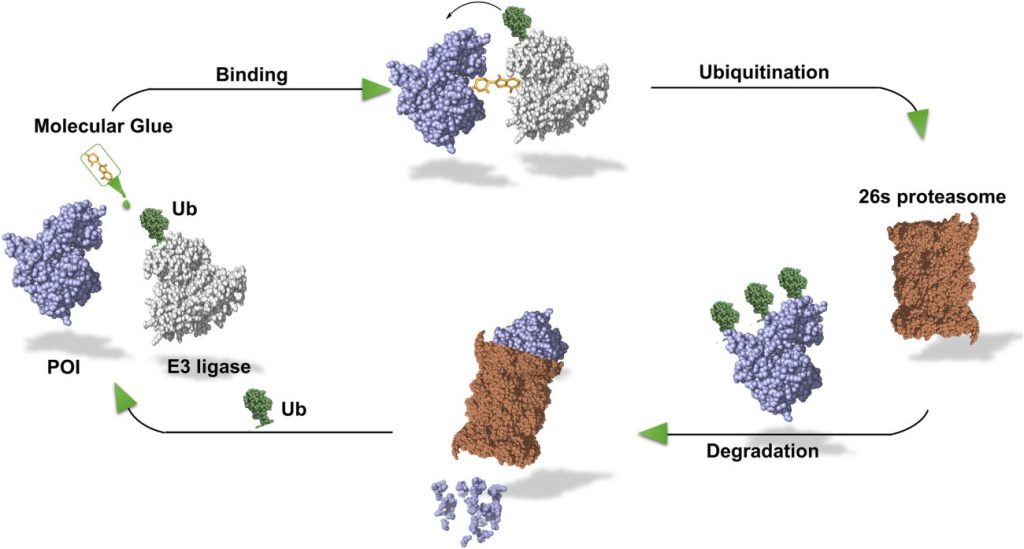
Figure 1. Mechanism of protein degradation induced by MGDs. Source: Wen J, Yu J, Wen W, Jiang B. Molecular Glue Degraders Redefining Targeted Therapies From Discovery to Therapeutic Applications. MedComm Oncol. 2026;5:e70058
What Are Molecular Glue Degraders? Definition, Structure, and Comparison with PROTACs
A molecular glue degrader is a monovalent small molecule, typically under 500 Da, that induces or stabilizes a de novo protein–protein interaction between an E3 ubiquitin ligase and a target protein, triggering its ubiquitination and proteasomal destruction. PROTACs achieve the same endpoint by a different route: two ligands joined by a synthetic linker, physically tethering the protein of interest to the ligase.
The practical differences in molecular glue vs PROTAC design are worth stating plainly:
- Architecture: molecular glues are monovalent and linker-free, while PROTACs are heterobifunctional, with a linker whose length, rigidity, and chemistry shape ternary complex geometry and must be optimized alongside both ligands.
- Physicochemistry: glues generally fall within Lipinski space, giving better permeability, oral bioavailability, and CNS access; PROTACs at 800-1,000 Da often struggle with solubility and efflux, but medicinal chemistry strategies such as macrocyclization, linker rigidification, and prodrug approaches have been developed to address this.
- Designability: PROTAC targets are predictable because both ligands are known; glues depend on an interface that does not exist until the compound is bound, which is why most were found rather than designed.
- Target scope: PROTACs require a binder for the protein of interest but can be assembled against almost any target that has one. Glues need no POI ligand, which opens up proteins with no ligandable pocket, but they are limited to targets that can form an inducible interface with the ligase.
How Molecular Glue Degraders Work: E3 Ligase Binding, Neosubstrate Recruitment, and Proteasomal Degradation
The molecular glue mechanism of action proceeds in three steps, whichever ligase is involved. First, the compound binds the E3 ligase substrate receptor: i.e., the tri-tryptophan thalidomide pocket of cereblon, a shallow surface pocket on DCAF15, or a reactive cysteine on DCAF16 or DCAF11, where engagement is covalent rather than reversible. Second, that binding remodels the receptor surface, creating a composite interface competent to capture a neosubstrate, a protein that is not a natural substrate of the ligase. Third, the rest of the complex builds a polyubiquitin chain on the neosubstrate, marking it for the 26S proteasome. The degrader then dissociates and engages another copy of the target, so ubiquitin-mediated degradation proceeds catalytically rather than stoichiometrically (one molecule can clear many).
The receptor is typically the only part the compound touches; the catalytic machinery around it is not modified. That modularity is why a single cullin scaffold can support hundreds of distinct ligases, and why degrader programs have somewhere to go when one stops working.
Selectivity comes from the degron, and its logic is ligase-specific. Most CRBN neosubstrates present a β-hairpin G-loop, while DCAF15 reads an α-helical epitope confined to RBM39 and its close relatives. In every case, cooperativity between ligase and substrate, rather than raw binary affinity, determines whether the ternary complex is productive, which makes binary affinity the first measurable checkpoint in the mechanism, not a surrogate for the outcome.
FDA-Approved Molecular Glue Degraders: From Thalidomide to Lenalidomide and Pomalidomide
Clinical validation came in reverse order: the drugs worked long before anyone knew why. Thalidomide was withdrawn in 1961 for teratogenicity and was in 2010 when it shown to bind cereblon. Four years later came the explanation for its anti-myeloma activity: thalidomide analogs redirect the CRL4^CRBN complex to degrade the transcription factors IKZF1 and IKZF3.
Lenalidomide and pomalidomide followed as more potent and more selective IMiDs, with lenalidomide also degrading CK1α. That same chemistry now drives a generation of IKZF1/IKZF3 degrader candidates, the CELMoDs, among them avadomide, mezigdomide, and CFT-7455.
The approved list grew in 2026. On August 13, the FDA granted accelerated approval to iberdomide (Zenbexus), combined with daratumumab and hyaluronidase-fihj and dexamethasone, for adults with multiple myeloma treated with at least one prior line of therapy. In the trial supporting approval (EXCALIBER-RRMM), 41% of patients on the iberdomide arm reached an MRD-negative complete response, against 21% on the comparator.
Beyond IMiDs: The Molecular Glue Pipeline in 2026 and Next-Generation Molecular Glue Degraders
Of the 600-plus E3 ligases in the human genome, fewer than a dozen have been exploited for degradation, and most of the field’s effort now goes into widening that number.
On the substrate side, CRBN still does most of the work, with candidates against GSPT1 (MRT-2359, CC-90009), IKZF2 (NVP-DKY709), VAV1 in immune indications (MRT-6160), WIZ for fetal hemoglobin induction in sickle cell disease, and NEK7 to block NLRP3 inflammasome assembly. But CRBN carries liabilities no amount of substrate expansion fixes: SALL4 degradation drives teratogenicity, and the ligase is frequently lost or mutated in IMiD-refractory disease.
Recruiting a different ligase is therefore the harder and more valuable move:
- DCAF15: reprogrammed by aryl sulfonamides such as indisulam and E7820 to degrade RBM39 through noncovalent interface extension.
- DCAF16 and DCAF11: engaged covalently at reactive cysteines. The DCAF11 molecular glue degrader IBG4 shows how covalent stabilization locks in an otherwise transient complex, and transposable covalent handles can convert known inhibitors into degraders.
- VHL: long established as a PROTAC handle, only recently shown to support true glues, with compounds degrading cysteine dioxygenase 1 (CDO1).
- KEAP1, SIAH1, β-TrCP, RNF126: earlier-stage, each with distinct recruitment logic.
Tumors that become refractory to IMiDs often do so by losing or mutating CRBN, which disables every CRBN-based degrader at once. A BTK degrader built on DCAF1 keeps working in exactly those cells, showing that resistance attaches to the ligase rather than to degradation as a strategy.
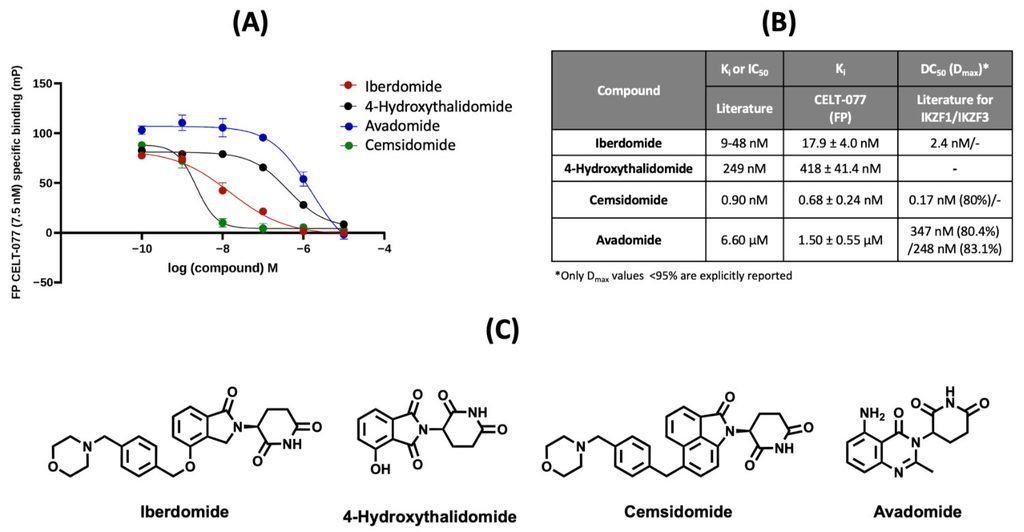
Figure 2. Validation of a CRBN fluorescence polarization assay using representative molecular glues, with Ki values compared to reported affinities and cellular degradation potencies. Source: González-Pico L, Camino T, Ortigueira S, Prieto-Díaz R, Sotelo E, Majellaro M. Bridging E3 Ligase Binding and Targeted Degradation Through Fluorescence Polarization. Int J Mol Sci. 2026;27(18):8054.
Identifying Molecular Glue Degraders: Screening Strategies and E3 Ligase Binding Assays
Molecular glue drug discovery runs along two routes. Phenotypic screening reads out viability or reporter degradation without presupposing a target and has delivered several first-in-class glues, at the cost of laborious target deconvolution. Target-based screening (fluorescence polarization, TR-FRET, DEL selection, NanoBiT complementation, or protein microarrays) measures engagement with a defined ligase directly, and scales to large libraries without reoptimization. The catch is that it only works where a validated assay for that ligase already exists.
Because glues initiate their mechanism through ligase engagement, a quantitative E3 ligase binding assay is the earliest informative filter in either route, and the same applies to the E3-binding arm of a PROTAC. In a competitive fluorescence polarization format, a fluorescent tracer bound to the recombinant ligase complex is displaced by unlabeled compounds in proportion to affinity, giving IC50 values convertible to Ki in a single homogeneous step. Run before cellular work, a CRBN binding assay or its VHL or other E3 ligase equivalent tells you whether the compound engages the ligase at all. A degradation blot cannot distinguish poor binding, poor permeability, unproductive ternary geometry, and inefficient ubiquitination; all produce the same missing band.
At Celtarys, we offer a ready-to-use E3 ligase kit, with validated fluorescent ligands and optimized FP protocols you can run in a single day, plus FP-based screening services delivering full IC50/Ki curves.
Contact us to discuss your degrader program.
References
Eladl O. Molecular glues and PROTACs in targeted protein degradation: mechanisms, advances, and therapeutic potential. Biochem Pharmacol. 2025;242:117297. doi: 10.1016/j.bcp.2025.117297
FDA. FDA grants accelerated approval to iberdomide with daratumumab and hyaluronidase-fihj and dexamethasone for multiple myeloma [Internet]. Silver Spring (MD): U.S. Food and Drug Administration; 2026 Aug 13 [cited 2026 Oct 14]. Available from: https://www.fda.gov/drugs/resources-information-approved-drugs/fda-grants-accelerated-approval-iberdomide-daratumumab-and-hyaluronidase-fihj-and-dexamethasone
González-Pico L, Camino T, Ortigueira S, Prieto-Díaz R, Sotelo E, Majellaro M. Bridging E3 Ligase Binding and Targeted Degradation Through Fluorescence Polarization. Int J Mol Sci. 2026;27(18):8054. doi: 10.3390/ijms27188054
Sasso JM, Tenchov R, Wang D, Johnson LS, Wang X, Zhou QA. Molecular Glues: The Adhesive Connecting Targeted Protein Degradation to the Clinic. Biochemistry. 2023;62(3):601–623. doi: 10.1021/acs.biochem.2c00245
Wen J, Yu J, Wen W, Jiang B. Molecular Glue Degraders Redefining Targeted Therapies From Discovery to Therapeutic Applications. MedComm Oncol. 2026;5:e70058. doi: 10.1002/mog2.70058
Zhang Y, Li L, Xu J, Che C, Jia J, Lu H, You Q, Xu X. A Novel Paradigm for Targeting Challenging Targets: Advancing Technologies and Future Directions of Molecular Glue Degraders. Molecules. 2026;31(3):459. doi: 10.3390/molecules31030459
Related posts
Picking an E3 Ligase Assay: FP, TR-FRET, ELISA, NanoBRET and More

PROTAC Hook Effect: How E3 Ligase and Target Protein Binding Affinity Shapes Degradation Efficiency



VHL, CRBN, and Emerging Ligases like DCAF: Selecting E3 Ligase Handles for PROTAC Drug Discovery



Esta entidad fue beneficiaria de las ayudas para la ejecución de acciones de promoción exterior de las empresas gallegas. El objetivo principal de estas ayudas es incentivar la realización de acciones de promoción exterior generadoras de ventajas competitivas. El resultado que se pretende alcanzar es el impulso de las pymes y sus productos y servicios, aumentando el número de empresas de base exportadora.




PERTE SALUD Proyecto Nº: IDI-2025-0751
Título: TERAPIAS AVANZADAS EN INMUNOONCOLOGÍA: UNA ESTRATEGIA INNOVADORA
BASADA EN LA DEGRADACIÓN DIRIGIDA DE GPCR EN EL EJE ADENOSINÉRGICOS

EIC Pathfinder; Project name: Unisens; Universal GPCR Activity Sensor for Next Generation Drug Discovery

Esta entidad fue beneficiaria de las ayudas para la ejecución de acciones de promoción exterior de las empresas gallegas. El objetivo principal de estas ayudas es incentivar la realización de acciones de promoción exterior generadoras de ventajas competitivas. El resultado que se pretende conseguir es el impulso de las pymes y sus productos y servicios, aumentando el número de empresas de base exportadora.
Celtarys Research is beneficiary of a WomenTechEU grant supporting deep-tech start-ups led by women


Principia 2021 Program
Celtarys staff has been funded by the Xunta de Galicia within the framework of the PRINCIPIA 2021 Program of the Galician Innovation Agency (GAIN)
InnovaPEME Program
Celtarys Innovation Plan has been funded by the InnovaPEME 2022 program of the Galician Innovation Agency (GAIN)

Bonos de Innovación de Celtarys Research (026)
Para promover o desenvolvemento tecnolóxico, a innovación e unha investigación de calidade. Esta operación está financiada pola Xunta de Galicia, a través de axudas concedidas pola Axencia Galega de Innovación, dentro do programa de axudas a empresa Bonos de innovación 2022.


Celtarys Research is part of the public-private consortium developing the project PREDICTEAM
New prognostic quantitative biomarker assays for predicting patient response to immune checkpoint inhibitor (ICI) treatment


NEOTEC · CDTI — Ministerio de Ciencia e Innovación
The Project ‘New chemical conjugation technology for therapeutic targets’ has been founded by CDTI under its program NEOTEC. The NEOTEC program objective is supporting the establishment and consolidation of technology-based enterprises. A technology-based company (EBT) is a company whose activity focuses on the exploitation of products or services that require the use of technologies and knowledge developed since the research activity. The EBT base their business strategy or activity in the intensive domain of scientific and technical knowledge. Budget awarded: 416.177€ | Execution dates: 1/1/2023 – 31/03/2024